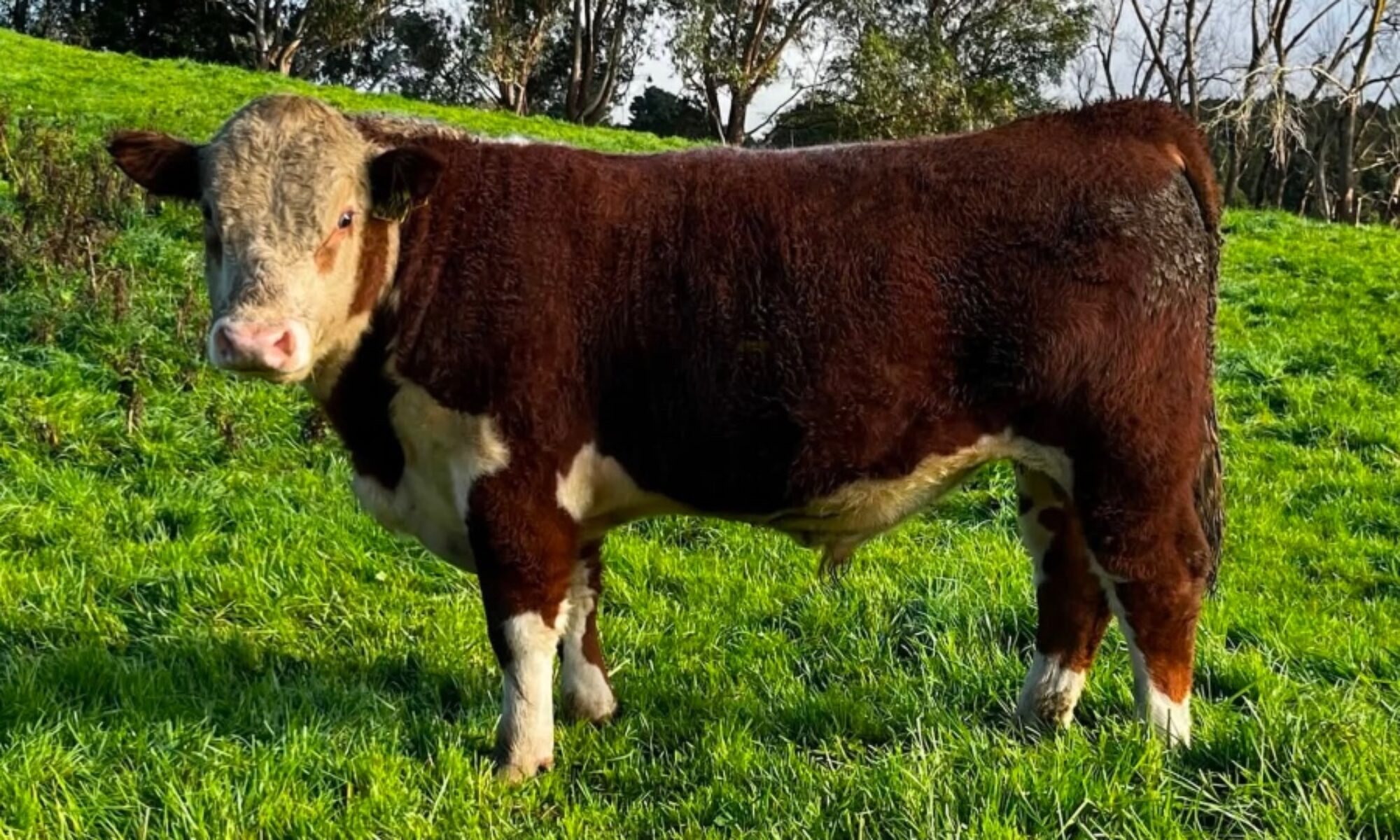
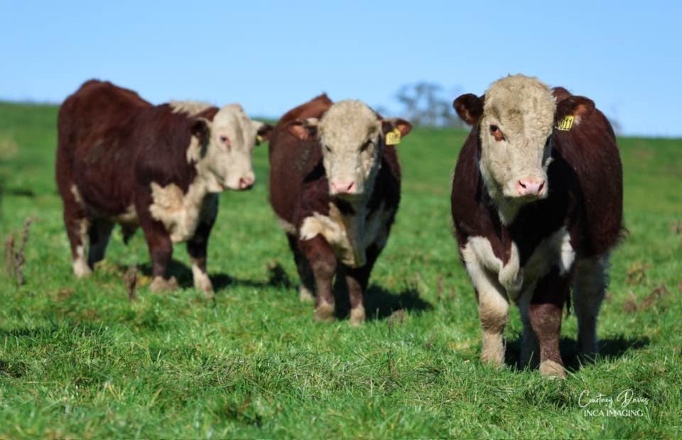
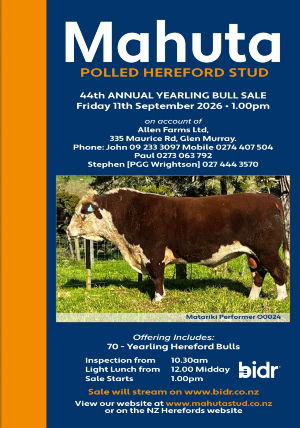
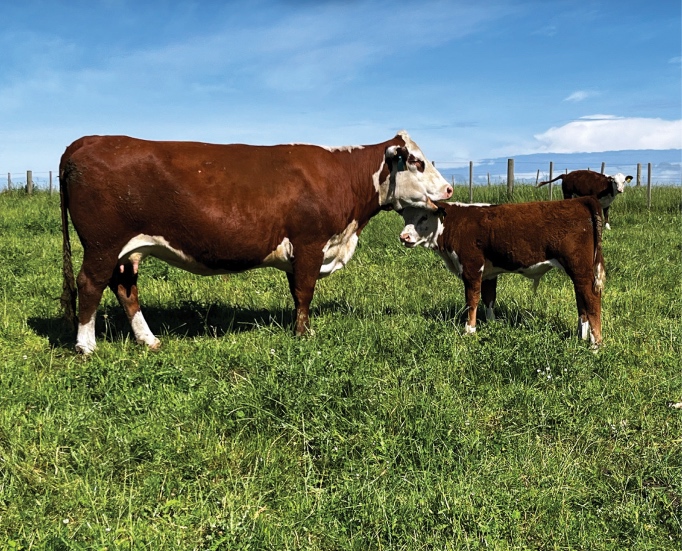
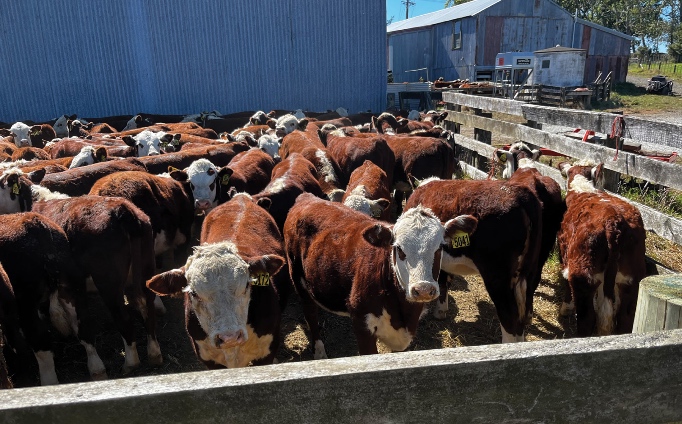
Mahuta Hereford Stud held their annual yearling bull sale on the farm on Friday, 11th September 2026. Sixty nine bulls were offered and all sold with an average of $7,370.00. It was a strong sale with spirited bidding throughout.
Top price was lot 10 sold to Maranui Herefords for $17,500.00. Second equal top price was for $16,000.00 to Arabica Herefords, Red Oaks Herefords and Okawa Herefords. Stud transfers were also made to Kaipara Herefords ($10,000.00) and Otamatea Herefords for $10,700.00 and $9,000.00. In addition there were 5 commercial sales over $10,000.00.
John and Mary would like to thank all those involved in a successful sale including buyers, under bidders, agents, friends and family helpers.
Welcome everyone to our 44th annual yearling bull sale that will be held on Friday 11th September 2026. In this sale, we are offering 70 yearling Hereford bulls, with progeny from Koanui Lips T 147, a sire bull with excellent phenotype and outstanding data.
Inspection will start at 10.30 am, then followed by light lunch at 12.00 pm and the sale at 1.00 pm. Sale will be done on site and also through online auction bidr.co.nz with the sale catalogue can be viewed here. An Open Day will be held on Friday 28th August from 11.00 am.
Here is a letter of introduction to this year’s Mahuta Sale Catalogue:
Dear Clients and Fellow breeders,
It’s that time of the year again leading up to our Annual Yearling Bull Sale on Friday 11th September. Just a reminder that we will have an Open Day on August 28th when the bulls will be on display. The purpose of this letter is to inform you about the sale bulls and the sale catalogue.
We have had a very kind winter and the bulls are looking good. We have had a good calving with 100% out of the mixed-age cows so far.
The catalogue is full of good bulls. You may have seen from advertising that average calving ease is way above average while 600day growth is also above average and carcase weight well above average. This reflects the meat on the bulls. The catalogues have been posted and if you want a catalogue and have not received one within the next few days, please let us know.
All the bulls have been tested for parentage, genetic defects, and augmenting EBVs. Unfortunately some results have not come through for some unclear reason. The tests have been repeated and results should be available by sale day.
We believe that the Beef-Heifer Index is the one which best suits our farming operation [and those of most of our clients]. This is designed to estimate profitability from a farming system where calving ease is important but growth and carcase are also important. It is designed to estimate profits from a system where yearling heifers are mated and progeny finished but is applicable to cow breeding operations where calving ease is required. 43 of the sale bulls have a Beef Heifer Index in the top 20% of the breed [trans-Tasman] and 32 have a Hereford Prime Index in the top 20%. In our opinion this means that they are productive animals which should add profit to most breeding operations.
At this stage there are no changes to the catalogue but any changes will be posted on Facebook the day before the sale. There will also be a sheet with final weights of the bulls and scrotal circumferences. These will also be available on sale day.
Thanks for your patience in reading this letter. We wish you well with your purchases and we would be keen to hear about any problems with bulls’ performance.
Wishing you all the best for the coming season.
John and Mary Allen 11th August 2026
Mahuta Annual Yearling Bull Sale Catalogue 2026 ebook.
Efficiency is increasingly recognised as one of the most critical challenges facing New Zealand’s beef sector, and for Mahuta Polled Hereford Stud it sits firmly at the heart of its breeding philosophy with an upcoming bull sale on 10 September.
Based south of the Bombay Hills and owned by John and Mary Allen, the stud has spent more than four decades refining a programme focused on producing cattle that convert grass into high-quality beef as efficiently as possible.
High calf survival, strong fertility and a condensed calving period are all central to that goal, alongside the ability to finish animals quickly and with minimal inputs.
“We are aiming to breed the best animals in terms of converting grass to meat and for that meat product to be of the highest quality,” says John. “It goes without saying that good beef animals have to be structurally correct. An animal which breaks down is inefficient on multiple levels.”
He says studies in the United States have shown Herefords to be particularly effective at converting pasture into beef and Mahuta has built on that advantage by selecting for traits that reduce maintenance and environmental impact.
“We also aim for lower mature cow size which means lower maintenance – less feed and fewer greenhouse gases,” says John. “Cattle which finish earlier spend less time on farm, which again improves efficiency across feed use, emissions and overall cost.”
Another key trait is calving ease: “Dead calves are inefficient and calves requiring assistance cost time, money and lost production,” says John. “We aim for as much growth as our calving ease limitations will allow while also selecting for negative gestation to give cows more days in milk.”
He says Mahuta’s long-standing focus on fertility and performance is evident in its herd, which consistently achieves days-to-calving figures well above the breed average. Carcass traits are equally important with emphasis placed on animals that deliver higher dressing-out percentages and strong eating quality.
“Intramuscular fat dictates eating quality and means the carcass is likely to attract a premium, which increases profit per animal,” says John. “That is efficiency in its simplest form.”
These principles are reflected in recent genetic investments including the purchase of Matariki Performer P24 and Colraine Washington 23 421, the latter setting a spring sale record of $37,000 for a yearling bull. The first progeny of both sires will feature in this year’s sale.
“These additions mean we are investing in the most productive genetics we can find, which in turn means the bulls we sell have higher-end productive potential and therefore profitability,” says John
Both sires rank highly across key performance indicators, including calving ease, growth and intramuscular fat, and sit in the top one per cent for beef heifer index, a combined measure of profitability.
“EBVs are an estimate of productive potential while indexes estimate dollar profitability,” says John. “Being in the top one per cent gives a strong indication of the value these bulls can deliver in a commercial system.”
At its on-farm sale, with online bidding available via Bidr, the stud will present its top line-up of yearling bulls bred specifically for heifer mating.
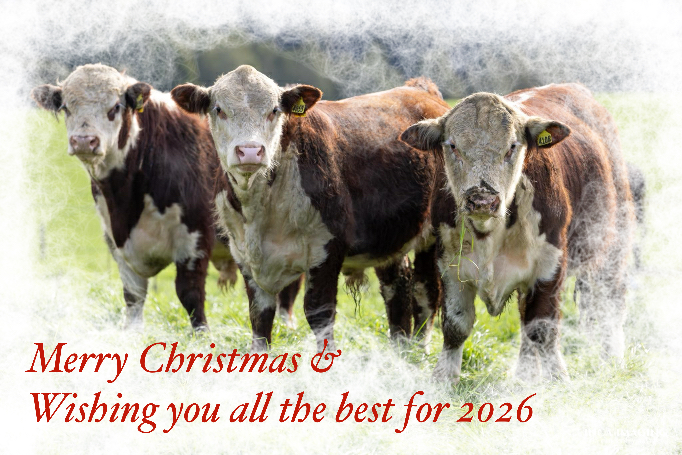
This is to wish you all a very Happy and relaxed Christmas and all the best for 2026. The season so far has been kind for us and we trust that it is for you too.
The fact that we are writing before Christmas is something of a record and we owe our level of organisation to our very good staff. We have Paul who is our new manager and Shane who is his assistant and we all work well together.
We hope that your bulls have done their job and we would appreciate your contacting us if there have been breakdowns.
We have realised that we don’t often have an opportunity to explain the aims of our breeding program and we hope that you don’t mind that we take this opportunity. This is important because bulls tend to breed to the average of the herd that they are bred from and so the aims of a breeding program are important in the purchase of any bull.
There is one key word that sums up our program and that is ‘efficiency”. We are aiming to breed the best animals in terms of converting grass to meat and for that meat product to be of the highest quality. It goes without saying that good beef animals have to be structurally correct. An animal which breaks down is inefficient on multiple levels.
To summarise the traits which we value:
1. Calving ease. Dead calves are inefficient and calves requiring assistance cost time and money and lost production (and so are inefficient).
2. Growth. We aim for as much growth as our calving ease limitations will allow. Growth and birthweight are antagonistic traits and heifer-mating bulls require some compromise in terms of growth while allowing for safe calving.
3. Negative gestation is important for those requiring extra days for cows in milk and we aim for better than breed average
4. Meat. This is important as it is the product which is consumed and so the more meat an animal has the higher the dressed-out percentage and therefore more efficient.
5. Fat and small mature size. These factors are important for early finishing especially if the season is not favourable. We aim for a mature-weight ebv below the 400-day weight ebv and we want an animal which grows quickly to around 500 days and then more slowly enabling it to lay down fat and so finish.
6. Intramuscular fat. This dictates eating quality and means that the carcass is likely to attract a premium which again means efficiency as it increases profit per animal.
7. And finally fertility means shorter calving interval and more cows in calf per bull.
8. Not to forget the controversial climate influence, animals with smaller mature size require less maintenance and emit less greenhouse gasses and animals which finish quickly are similarly efficient.
Thank you for reading this far. We hope that it promotes thought and we would welcome further discussion or enquiries about viewing the stock.
Wishing you all the best for 2026.
John and Mary Allen
11th December 2025 Mahuta Herefords 335 Maurice Rd, R D 5, Tuakau 2695 0274407504